

Overhead vs. Underfloor Power Distribution:
Optimizing High-Density AI Layouts
Topic: Data Center Infrastructure // Product: Voltz PowerWhips
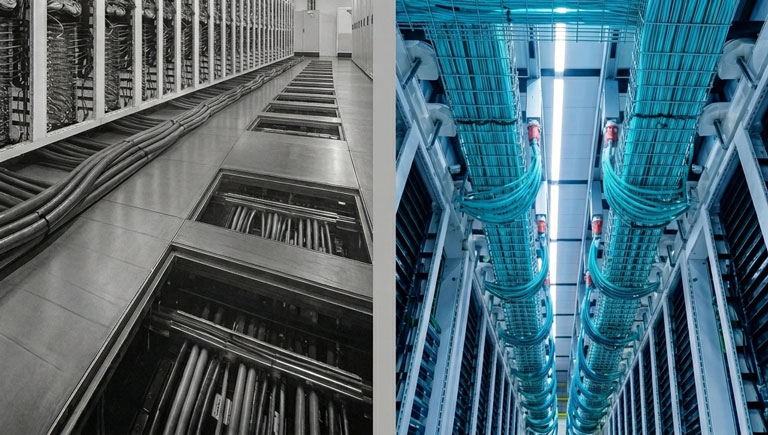
As data centers scale to accommodate intensive AI training clusters, infrastructure engineers face a fundamental dilemma: should power be distributed through an underfloor plenum or routed overhead?
With modern GPU-heavy racks demanding up to 100kW or more, this decision impacts more than just cable management—it directly dictates cooling efficiency, structural load balancing, and overall Power Usage Effectiveness (PUE).
Historically, raised floors served as the standard blueprint for data center power distribution, concealing branch circuit wiring while doubling as a cold-air delivery plenum. However, the sheer volume of high-amperage cabling required for hyperscale installations can create subfloor "cable spaghetti," choking off airflow and forcing cooling systems to work harder.
The Case for Overhead Power Pathways
To mitigate underfloor air obstructions, many forward-looking enterprise facilities are transitioning to overhead cable trays and busway architectures. Elevating your power distribution offers distinct advantages:
- Unobstructed Airflow: Removing heavy conduit bundles from the underfloor plenum maximizes static pressure, allowing cold air to reach high-density server inlets efficiently.
- Thermal Visibility: Overhead environments prevent heat from trapping under the floor, reducing localized thermal hotspots across your AI training cluster.
- Rapid Reconfiguration: Technicians can trace, inspect, and hot-swap connections without lifting floor tiles, accelerating maintenance windows.
Whether your facility utilizes an overhead busway or an underfloor Remote Power Panel (RPP) matrix, the critical link remains the branch circuit assembly. Standard, off-the-shelf patch cables cannot survive the thermal stresses or meet the rigorous compliance standards of these high-capacity environments.
Tailoring the Link: Voltz PowerWhips Custom Engineering
Regardless of your choice between overhead or underfloor routing, Voltz PowerWhips by Raptor Power Systems provide the tailored engineering required to bridge the gap between your main power source and IT racks.
Every data center layout requires a specific configuration to prevent slack from obstructing airflow or creating safety hazards. Voltz assemblies are fully customizable to meet exact infrastructure specifications:
- Conduit Dynamics: Choose Liquid-tight Flexible Metal Conduit (LFMC) for robust underfloor moisture protection and shielding, or lightweight non-metallic conduit (LFNC) for flexible, overhead basket tray routing.
- Connector and Load Matching: We build assemblies using a massive array of heavy-duty terminations—from standard NEMA locking plugs to industrial-grade IEC 60309 and CS configurations—supporting voltages from 125V up to 480V and amperages from 15A to over 100A.
- Certified Security: In high-density architectures, field-assembled cabling introduces an unnecessary risk of arc flash or structural failure. Every Voltz PowerWhip is a UL Listed cable assembly, 100% factory-tested for insulation resistance (Megger testing), continuity, and correct polarity before shipment.
Beating Infrastructure Lead Times
Transitioning or expanding a data center layout is frequently stalled by global component shortages, with overseas cable suppliers quoting lead times upwards of 16 weeks. Raptor Power Systems mitigates this vulnerability by manufacturing directly within our domestic facilities in Illinois and New Jersey. Our localized supply chain ensures rapid engineering support, 24-hour quoting, and an industry-leading 4-week production turnaround, keeping your commissioning timeline securely on track.
Optimizing your facility's path to power? Contact the Raptor Power Systems engineering team at (800) 258-0129 to configure custom Voltz PowerWhips tailored to your specific architecture layout.